
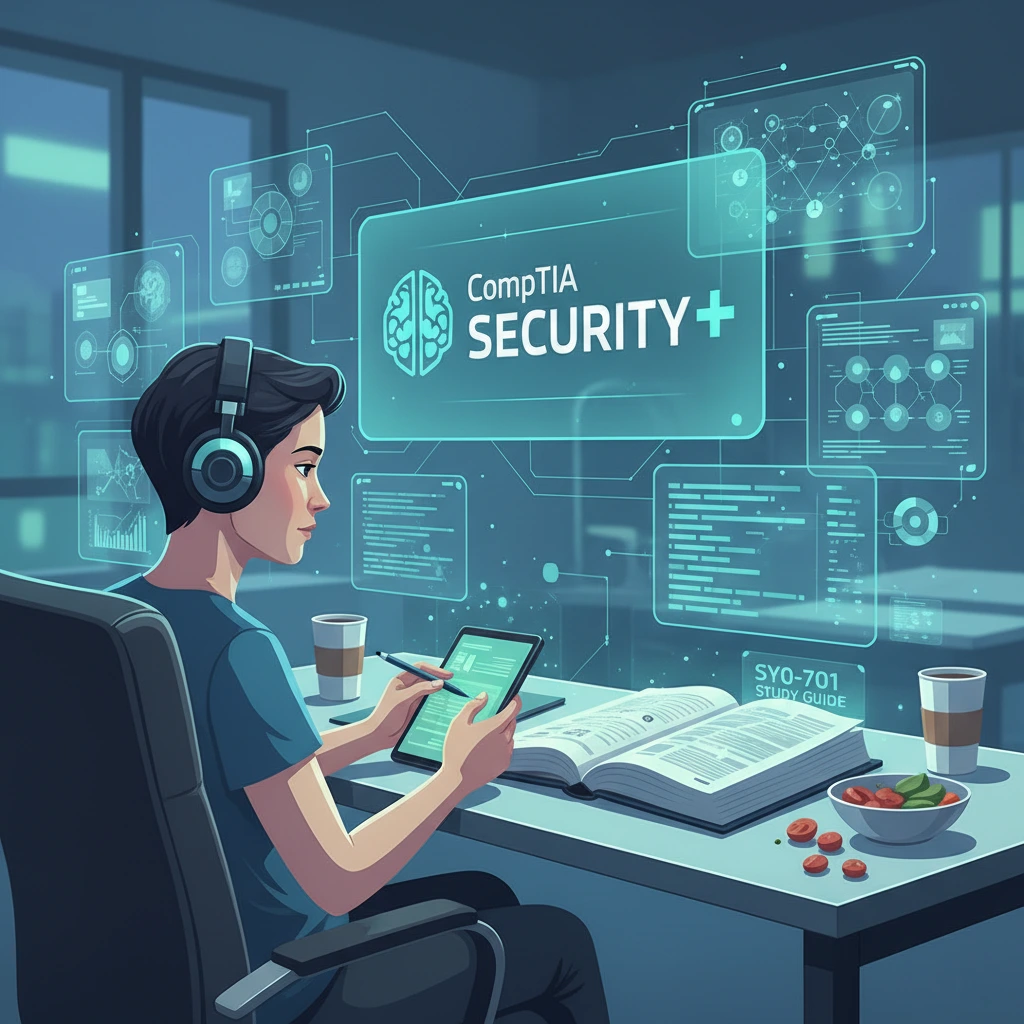
The CompTIA Security+ certification is a globally respected credential that validates essential cybersecurity skills. This CompTIA Security+ guide explains the exam, its structure, and how to prepare effectively.
Table of Contents
- What is the Exam
- Who Should Take This Exam
- Exam Format and Scoring
- Exam Cost, Registration, Eligibility
- Exam Domains and Weights
- Study Plan
- Preparation Strategy
- Common Mistakes to Avoid
- Detailed Tips for Passing
- How CertifHub Practice Tests Help
- Final Tips and Next Steps
- FAQ
- Sources
What is the Exam
The CompTIA Security+ exam is a vendor-neutral cybersecurity certification that validates baseline security skills required for IT and security roles. It focuses on risk management, network security, incident response, and secure architecture. As a foundational certification, it is recognized by organizations worldwide for verifying job-ready cybersecurity knowledge. Learn more cybersecurity insights on the CertifHub blog.
Who Should Take This Exam
This exam is ideal for aspiring cybersecurity professionals, entry-level IT technicians, help desk analysts, system administrators, and those transitioning into security roles. Government agencies and private-sector employers commonly require or recommend the Security+ certification.
Exam Format and Scoring
The CompTIA Security+ exam includes up to 90 questions combining multiple choice and performance-based tasks. You receive a scaled score between 100–900, and a minimum of 750 is required to pass. Performance-based questions simulate real security scenarios, testing analytical and troubleshooting abilities.
Exam Cost, Registration, Eligibility
The Security+ exam typically costs around $392, though pricing may vary by region. No formal prerequisites exist, but CompTIA recommends at least two years of IT administration experience with a security focus. Registration is completed through Pearson VUE, and candidates may take the exam online or at a testing center.
Exam Domains and Weights
The exam objectives are divided into clearly defined domains that reflect real-world cybersecurity responsibilities.
| Domain | Description |
|---|---|
| General Security Concepts | Foundational principles, controls, and frameworks |
| Threats, Vulnerabilities, Mitigations | Malware, attacks, threat actors, and defensive measures |
| Security Architecture | Network design, segmentation, and security components |
| Operations and Incident Response | Monitoring, digital forensics, and response procedures |
| Governance, Risk, and Compliance | Policies, regulations, and risk management processes |
For further certification resources, explore the CertifHub platform.
Start Practicing for the Security+ Exam
Prepare with realistic questions and improve your exam confidence.
Study Plan
A disciplined and structured study plan is essential for passing the CompTIA Security+ exam. Following a consistent schedule will help you cover each domain thoroughly.
- Allocate 6–8 weeks of study time with daily review sessions.
- Use videos, books, labs, and practice tests to build hands-on familiarity.
Preparation Strategy
A balanced preparation strategy includes theory, practice, and scenario-based learning. Simulating real incident response and troubleshooting tasks will significantly increase your performance on performance-based questions.
Common Mistakes to Avoid
- Relying only on memorization instead of understanding core security concepts.
- Skipping performance-based practice questions.
Detailed Tips for Passing
- Master command-line tools such as netstat, nmap, and tcpdump.
- Understand how to analyze logs, alerts, and threat intelligence reports.
How CertifHub Practice Tests Help
CertifHub provides timed practice tests, detailed explanations, and difficulty-balanced question sets that mirror real exam conditions. These tools help you strengthen weak areas and boost exam readiness.
Boost Your Security+ Readiness
Strengthen your weak areas with targeted practice exams.
Final Tips and Next Steps
Create a revision schedule, review incorrect answers from practice tests, and practice scenario-based questions regularly. Focus on understanding concepts rather than memorizing definitions.
FAQ
Is CompTIA Security+ good for beginners?
Yes. It serves as an ideal entry-level cybersecurity certification.
How long should I study for Security+?
Most candidates prepare for 6–10 weeks depending on experience.
Are performance-based questions difficult?
They require hands-on thinking but become manageable with practice.
Does the certification expire?
Security+ is valid for three years and can be renewed through CEUs.
Can I take the exam online?
Yes, CompTIA offers online proctored testing through Pearson VUE.
Is the Security+ exam multiple choice?
It includes both multiple-choice and performance-based questions.
Which version of the exam is current?
CompTIA periodically updates the exam; check the official site for the latest version.
Do I need IT experience?
It is recommended but not strictly required.
Is the Security+ recognized by employers?
Yes, it is widely respected across government and private sectors.
What is the passing score?
You need a score of 750 on a 100–900 scale.