
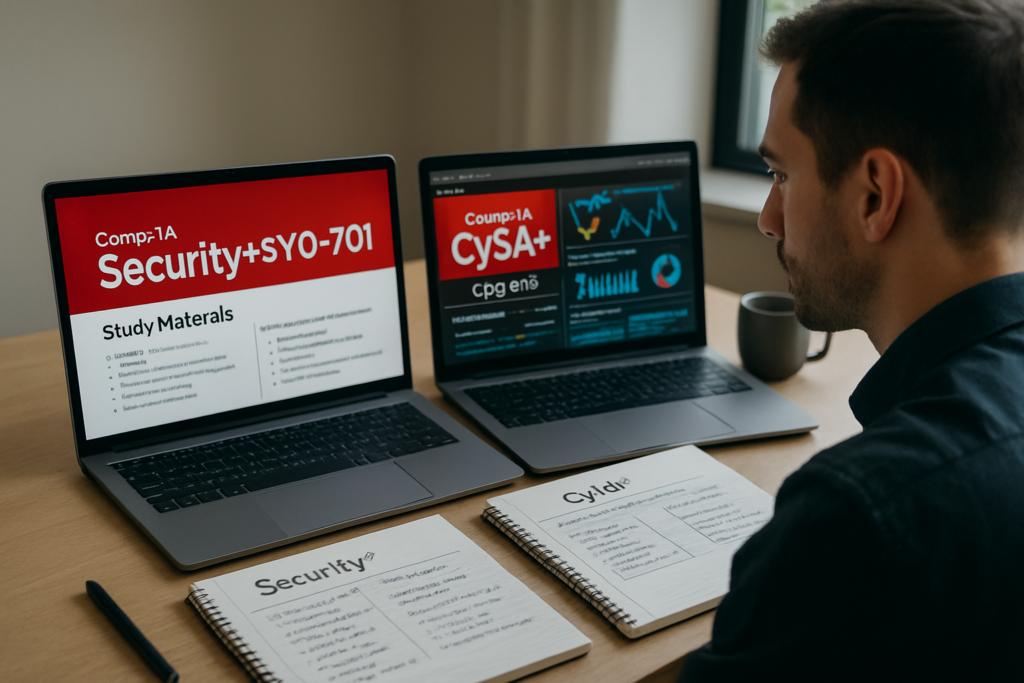
TL;DR: Security+ is the entry-level choice for newcomers to cybersecurity, covering foundational security concepts and opening doors to analyst and help desk roles. CySA+ is intermediate-level, requiring 3-4 years of experience and focusing on threat detection, vulnerability management, and incident response. Start with Security+ if you're new to the field; pursue CySA+ once you have hands-on security experience and want to specialize in SOC or threat analysis roles.
Quick Comparison: CySA+ vs Security+
| Criterion | Security+ | CySA+ |
|---|---|---|
| Experience Level | Entry-level, no prerequisites | Intermediate; 3-4 years IT/security experience recommended |
| Current Exam Code (2026) | SY0-701 | CS0-003 |
| Primary Focus | Foundational security concepts, risk management, basic threat analysis | Advanced threat detection, vulnerability management, incident response |
| Typical Roles | Security Analyst (junior), Help Desk Technician, Systems Administrator | SOC Analyst, Threat Intelligence Specialist, Security Analyst (mid-level) |
| Exam Domains | 5 domains covering security fundamentals | 4 domains: threat/vulnerability management, software/systems security, security operations, incident response |
| DoD 8570 Baseline | IAT Level II, IAM Level I | IAT Level III, CSSP Analyst |
| Career Stage | First security certification | Second or third certification in security track |
Why Pick Security+ First?
Security+ serves as the industry's standard entry point into cybersecurity careers. The certification covers essential security concepts without assuming prior specialized knowledge, making it accessible to professionals transitioning from general IT roles or those starting fresh in security.
Strengths:
The certification provides comprehensive coverage of security fundamentals including network security, cryptography, identity and access management, risk management, and security architecture. As of 2026, the SY0-701 exam aligns with current industry practices for baseline security knowledge. Security+ holds DoD 8570 IAT Level II approval, making it a requirement for many government and contractor positions.
The exam's practical performance-based questions test real-world application of concepts rather than pure memorization. You'll encounter scenarios involving security tool configuration, log analysis, and incident identification—skills that translate directly to day-one job responsibilities.
Weaknesses:
Security+ covers breadth over depth. While you'll understand security concepts across multiple domains, you won't develop the specialized analytical skills needed for dedicated threat hunting or SOC analyst roles. The certification doesn't include hands-on lab components during the exam preparation process, though performance-based questions simulate some practical scenarios.
For experienced professionals already working in security operations, Security+ may feel too basic. The certification won't differentiate you in competitive job markets if you're applying for mid-level or senior positions.
Who It's For:
Security+ targets IT professionals with 2+ years of general IT experience who want to pivot into security. According to industry training providers, this certification is recommended as the first step for those new to cybersecurity roles. It's ideal for help desk technicians, systems administrators, and network engineers looking to specialize in security functions.
The certification also serves military personnel and government contractors who need to meet DoD 8570 baseline requirements for information assurance roles.
Why Pick CySA+ for Advanced Skills?
CySA+ (Cybersecurity Analyst) represents CompTIA's intermediate-level security certification, designed for professionals who already understand security fundamentals and need to develop specialized analytical capabilities. The CS0-003 exam, current as of 2026, emphasizes hands-on threat detection and response skills.
Strengths:
CySA+ dives deep into behavioral analytics, threat intelligence, and vulnerability management—skills that Security+ only touches on superficially. The certification prepares candidates for roles such as Security Analyst, SOC Analyst, and Threat Intelligence Specialist, with curriculum reflecting 2026 industry standards for relevant cybersecurity skills.
The exam's four domains—threat and vulnerability management, software and systems security, security operations and monitoring, and incident response—align precisely with day-to-day responsibilities in security operations centers. You'll work with SIEM tools, analyze indicators of compromise, conduct vulnerability assessments, and develop incident response procedures.
CySA+ carries DoD 8570 IAT Level III and CSSP Analyst approvals, qualifying you for higher-level government positions than Security+ alone. The certification demonstrates capability to handle complex security incidents and proactive threat hunting, not just reactive security administration.
Weaknesses:
CySA+ assumes foundational knowledge that many candidates lack. Attempting this certification without prior security experience or Security+ knowledge leads to significant struggle with exam concepts. The certification requires understanding of security tools, log formats, and attack methodologies that only come from hands-on work.
The exam's difficulty level reflects its intermediate positioning—pass rates are lower than Security+, and the performance-based questions demand practical experience with security tools and techniques. Study materials alone won't prepare you adequately without real-world context.
Who It's For:
CySA+ is designed for professionals with 3-4 years of IT or security experience, making it better suited for those with an established background rather than entry-level candidates. Target candidates include junior security analysts ready to advance, network administrators who have taken on security responsibilities, and IT professionals who have completed Security+ and gained 1-2 years of security-focused work experience.
The certification particularly benefits professionals working in or targeting SOC environments, where threat detection and incident response form core job functions.
Which Certification Should You Pursue First?
Choose Security+ if:
- You're new to cybersecurity with limited security-specific experience
- You need to meet DoD 8570 IAT Level II requirements
- You're transitioning from general IT roles (help desk, systems admin, networking)
- You want the broadest possible foundation before specializing
- You're targeting junior security analyst or security administrator positions
- You need a certification that's widely recognized across all industry sectors
Choose CySA+ if:
- You already hold Security+ or equivalent foundational security knowledge
- You have 3+ years of hands-on IT or security experience
- You're currently working in security operations and want to formalize your skills
- You're targeting SOC analyst, threat intelligence, or incident response roles
- You need DoD 8570 IAT Level III or CSSP Analyst qualification
- You want to specialize in threat detection and vulnerability management
The Recommended Path:
For most professionals, the optimal progression is Security+ first, followed by 12-24 months of hands-on security work, then CySA+. This approach builds foundational knowledge before layering on specialized analytical skills. Attempting CySA+ without Security+ or equivalent experience typically requires significantly more study time and results in lower retention of exam concepts.
Experienced IT professionals with substantial security responsibilities may skip Security+ if they're confident in their foundational knowledge, but this carries risk—CySA+ exam questions assume you've mastered Security+ concepts and build upon them rather than reviewing basics.
What About Career ROI and Salary Impact?
Both certifications deliver measurable career value, but at different stages. Security+ opens doors that remain closed to candidates without security credentials—many organizations won't interview for security positions without at least one relevant certification.
CySA+ differentiates you in competitive job markets once you're past the entry level. The certification signals specialized capability in threat analysis and incident response, skills that command premium compensation in 2026's tight cybersecurity labor market.
Salary impact depends heavily on your existing experience and role. Security+ may increase earning potential by 10-15% for candidates moving from general IT into security positions. CySA+ typically correlates with mid-level security analyst salaries, which represent a significant step up from junior positions—though the certification alone won't secure those roles without corresponding experience.
Exam Preparation and Study Resources
Security+ preparation typically requires 40-60 hours of study for candidates with solid IT fundamentals. Focus on understanding concepts rather than memorizing definitions—the exam tests application of knowledge through scenario-based questions. Official CompTIA study materials, practice exams, and hands-on labs with security tools provide adequate preparation.
CySA+ demands 60-100 hours of study even for experienced professionals. The exam's emphasis on tool usage and log analysis means you need access to SIEM platforms, vulnerability scanners, and packet analysis tools during preparation. Virtual labs and sandbox environments become essential rather than optional.
Both exams include performance-based questions that simulate real-world tasks. You might configure firewall rules, analyze network traffic captures, or identify security incidents from log data. These questions carry significant weight in your final score and require hands-on practice to master.
Maintaining Your Certification
Both Security+ and CySA+ operate under CompTIA's continuing education model. Certifications remain valid for three years from your pass date. Renewal requires earning 50 continuing education units (CEUs) for Security+ or 60 CEUs for CySA+ through activities like attending conferences, completing training courses, or earning higher-level certifications.
Alternatively, retaking the current exam version renews your certification for another three years. Many professionals choose to pursue the next certification in CompTIA's security track—CySA+ after Security+, then CASP+ or PenTest+—which automatically renews lower-level certifications.
FAQ
Can I take CySA+ without Security+ first?
Yes, CompTIA doesn't enforce prerequisites for CySA+. However, the exam assumes you have Security+ level knowledge plus 3-4 years of hands-on experience. Most candidates who skip Security+ find CySA+ significantly more difficult and require substantially more study time. Unless you have extensive security operations experience, starting with Security+ provides better knowledge retention and higher pass rates.
Which certification is harder, Security+ or CySA+?
CySA+ is considerably harder than Security+. The exam covers more advanced concepts, requires deeper understanding of security tools and techniques, and includes more complex performance-based questions. CySA+ assumes you've mastered Security+ material and builds upon it rather than reviewing fundamentals. Pass rates for CySA+ are lower, and most candidates report needing more study time despite having prior security experience.
Do employers prefer Security+ or CySA+ for entry-level roles?
Employers prefer Security+ for true entry-level security positions. Most job postings for junior security analysts, security administrators, and SOC tier 1 positions list Security+ as a requirement or strong preference. CySA+ appears more frequently in mid-level job requirements where employers expect candidates to have prior security experience. Holding CySA+ without experience doesn't typically compensate for lack of hands-on work in entry-level hiring decisions.
How long should I wait between Security+ and CySA+?
Wait 12-24 months of active security work between Security+ and CySA+. This timeframe allows you to gain hands-on experience with security tools, incident response procedures, and threat analysis—practical skills that CySA+ tests extensively. Pursuing CySA+ immediately after Security+ without intervening work experience leads to memorization-based studying rather than true skill development, reducing the certification's value to both you and employers.
Does CySA+ qualify for government security clearance jobs?
CySA+ qualifies for DoD 8570 IAT Level III and CSSP Analyst baseline certifications, making it valid for government and contractor positions requiring those designations. This represents a higher approval level than Security+ (IAT Level II). However, certification alone doesn't grant security clearance—that's a separate background investigation process. CySA+ satisfies the technical certification requirement for positions that require clearance and IAT III/CSSP Analyst baseline.
Can I use CySA+ to renew my Security+ certification?
Yes, earning CySA+ automatically renews your Security+ certification for three years from the CySA+ pass date. CompTIA's continuing education program treats higher-level certifications as renewal activities for lower-level certs in the same track. This means you don't need to separately maintain Security+ once you hold CySA+, as long as you keep CySA+ current through its own renewal requirements.