
Last updated: December 2025
Passing the PSM I certification can feel overwhelming when you’re staring at an 80-question exam with only 60 minutes on the clock and an 85% passing requirement. But here’s what many candidates don’t realize: with the right preparation strategy and deep understanding of the Scrum framework, you can confidently pass this exam on your first attempt without mandatory training courses.
The Professional Scrum Master I certification from Scrum.org has become the gold standard for Scrum practitioners worldwide, recognized for its rigorous knowledge-based assessment rather than simple attendance requirements. Unlike other certifications where you simply attend a class and receive your certificate, PSM I validates genuine mastery of Scrum principles through a challenging examination that separates those who truly understand Scrum from those who merely memorize it.
In this comprehensive guide, you’ll discover everything you need to pass the PSM I exam, including detailed exam specifications, a proven study plan, essential resources, common pitfalls to avoid, and career insights that demonstrate why this certification remains one of the most valuable credentials in Agile project management.
Table of Contents
- What is Professional Scrum Master I (PSM I)?
- PSM I Exam Details
- Exam Domains and Focus Areas
- Recommended Study Resources
- 3-Week Study Plan for PSM I Success
- Exam Day Tips and Strategies
- Common Mistakes to Avoid
- Is PSM I Worth It in 2025?
- Frequently Asked Questions
- Next Steps: Start Your PSM I Journey
The Professional Scrum Master certification landscape has evolved significantly in 2025, with PSM I maintaining its position as the most respected entry-level Scrum credential. Industry data shows that certified Scrum Masters earn an average of $125,436 annually in the United States, representing a significant premium over non-certified project managers. With the continued adoption of Agile methodologies across industries from technology to healthcare, the demand for skilled Scrum Masters who can demonstrate validated knowledge through certifications like PSM I has never been higher.
What is Professional Scrum Master I (PSM I)?
The Professional Scrum Master I certification validates your fundamental understanding of the Scrum framework, its roles, events, artifacts, and the principles that underpin empirical process control. Offered by Scrum.org—founded by Scrum co-creator Ken Schwaber—PSM I demonstrates your ability to apply Scrum theory and practices in real-world situations.
Who Should Pursue PSM I:
- Aspiring Scrum Masters seeking to enter Agile project management
- Current Scrum Masters looking to validate their knowledge with a recognized credential
- Project Managers transitioning to Agile methodologies
- Product Owners and Developers who work closely with Scrum teams
- Agile Coaches and consultants establishing professional credibility
- Anyone working in Agile environments who wants to understand Scrum deeply
Prerequisites:
- No formal prerequisites or mandatory training required
- Strong understanding of the Scrum Guide recommended
- Practical experience with Scrum teams helpful but not required
- Self-study through official Scrum.org resources sufficient for most candidates
Professional Value:
PSM I certification differentiates itself through its rigorous, knowledge-validated approach. While other certifications like CSM from Scrum Alliance require mandatory training attendance, PSM I focuses purely on demonstrating mastery through examination performance. According to recent salary surveys, certified Scrum Masters earn between $102,000 and $152,500 annually depending on experience level, location, and additional skills. The certification carries lifetime validity with no renewal fees, making it one of the most cost-effective professional credentials available.
What makes PSM I particularly valuable is Scrum.org’s commitment to maintaining high standards. The 85% passing threshold ensures that certificate holders genuinely understand Scrum rather than simply memorizing answers. This rigor has earned PSM I recognition as the most respected Scrum certification in the industry, with employers specifically seeking PSM-certified candidates for Scrum Master roles.
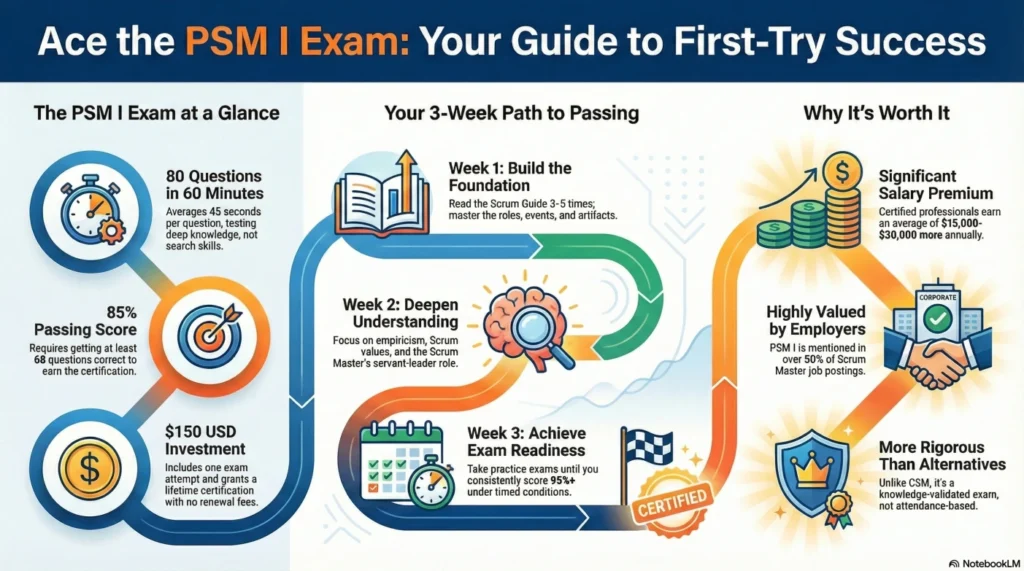
PSM I Exam Details
| Element | Details |
|---|---|
| Exam Code | PSM I |
| Number of Questions | 80 questions |
| Question Types | Multiple choice, multiple answer, true/false |
| Exam Duration | 60 minutes |
| Time Per Question | 45 seconds average |
| Passing Score | 85% (68 out of 80 correct answers) |
| Cost | $150 USD per attempt |
| Available Languages | English (primary), with other languages available |
| Delivery Format | Online proctored exam, open book |
| Certification Validity | Lifetime (no renewal required) |
| Retake Policy | $150 USD for each additional attempt |
| Results | Immediate upon completion |
Important Exam Characteristics:
The PSM I exam is an open-book assessment, meaning you can technically reference materials during the exam. However, with only 45 seconds average per question, there’s virtually no time to look up answers. This design intentionally tests your deep understanding rather than your ability to search for information. Many candidates finish the exam in 30-45 minutes, using the remaining time to review flagged questions.
Questions range from straightforward knowledge checks directly from the Scrum Guide to complex scenario-based questions that require applying Scrum principles to real-world situations. Approximately 15-20% of questions come directly from the free Scrum Open Assessment, while the majority test deeper understanding through situational scenarios where multiple answers may seem correct.
The exam uses precise language where single words can change the correct answer. For example, questions may ask what a Scrum Master “should” do versus what they “could” do, or whether someone can “attend” versus “participate” in an event. This precision reflects the careful language used in the Scrum Guide itself.
Exam Domains and Focus Areas
The PSM I exam evaluates your knowledge across multiple Professional Scrum Competencies defined by Scrum.org. Understanding these domains helps you structure your study approach and identify areas requiring deeper focus.
1. Understanding and Applying the Scrum Framework (30-35%)
This foundational domain covers the core elements of Scrum including roles (Scrum Master, Product Owner, Developers), events (Sprint Planning, Daily Scrum, Sprint Review, Sprint Retrospective), and artifacts (Product Backlog, Sprint Backlog, Increment). You must understand how these elements work together and their specific purposes within the framework.
Critical points to master:
- The three accountabilities in Scrum and their specific responsibilities
- Time-boxes for each Scrum event and their purposes
- The definition and purpose of each Scrum artifact
- What the Scrum Guide says versus common Agile practices not part of Scrum
- How the Sprint serves as the container for all other events
- The relationship between the Product Goal, Sprint Goal, and Definition of Done
💡 Pro Tip: Many candidates fail questions because they assume common Agile practices like story points, velocity charts, or burndown charts are part of Scrum. These are complementary practices teams may use WITH Scrum, but they’re not mentioned in the Scrum Guide. Focus on what Scrum IS, not what teams often do alongside it.
2. Scrum Theory and Principles (20-25%)
This domain tests your understanding of empiricism—the philosophical foundation of Scrum. You must grasp the three pillars (transparency, inspection, adaptation) and five values (commitment, focus, openness, respect, courage) and how they guide decision-making in complex environments.
Critical points to master:
- How transparency enables inspection and adaptation
- The relationship between empiricism and dealing with complexity
- How Scrum values influence team behavior and interactions
- Why Scrum uses time-boxing to promote regular inspection and adaptation
- The difference between defined processes and empirical processes
- How feedback loops create opportunities for improvement
3. Developing People and Teams (15-20%)
This area evaluates your understanding of servant leadership, coaching, and facilitation—the “how” of being an effective Scrum Master. Questions focus on enabling self-management, removing impediments, and fostering continuous improvement without micromanagement.
Critical points to master:
- The Scrum Master as a servant-leader, not a traditional manager
- How to coach without telling teams what to do
- Facilitating productive discussions without dominating them
- Enabling self-management rather than assigning tasks
- When and how to intervene when teams face challenges
- Building trust and psychological safety within teams
💡 Pro Tip: When answering situational questions, remember the Scrum Master is never the decision-maker for the team. If an answer suggests the Scrum Master should make a technical decision or assign work, it’s wrong. The Scrum Master facilitates and coaches but respects team self-management.
4. Managing Products with Agility (15-20%)
This domain covers Product Backlog management, stakeholder collaboration, and maximizing product value—areas where Scrum Masters support Product Owners and the broader organization.
Critical points to master:
- Product Backlog refinement and ordering principles
- The Product Owner’s accountability for maximizing value
- How Developers forecast work and manage the Sprint Backlog
- Stakeholder engagement strategies throughout the Sprint
- The Definition of Done and its role in ensuring quality
- Delivering Increments that provide value to stakeholders
5. Cross-Functional and Self-Organizing Teams (10-15%)
Questions in this area test your understanding of team dynamics, autonomy, and accountability. Scrum teams must be cross-functional (possessing all skills needed) and self-managing (choosing how to do their work).
Critical points to master:
- What makes a team truly cross-functional
- The difference between self-managing and self-organizing
- Why Scrum recognizes no sub-teams or hierarchies within the Developers
- How team size affects effectiveness (optimal 10 people or fewer)
- Individual specialization within collective accountability
- When and how to scale Scrum across multiple teams
Recommended Study Resources
Official Scrum.org Resources (Essential)
These official resources form the foundation of your preparation and should be your primary focus:
- The Scrum Guide (2020 version): The authoritative 14-page document defining Scrum. Read it at least 3-5 times, highlighting key phrases. Every sentence matters for the exam. Available free at scrumguides.org
- Scrum Open Assessment: Free 30-question practice test that includes some questions from the actual PSM I pool. Take it repeatedly until you consistently score 100% in under 10 minutes. Access at scrum.org
- Product Owner Open Assessment: Additional free practice covering Product Owner responsibilities. Many PSM I questions overlap with Product Owner knowledge. Available at scrum.org
- Scrum Master Learning Path: Curated articles, videos, and resources from Scrum.org that expand on Scrum Guide concepts. Access at scrum.org
- Scrum Glossary: Defines key Scrum terminology with precision. Essential for understanding exact meanings of Scrum-specific terms.
Recommended Books
- “Scrum: A Pocket Guide” by Gunther Verheyen: A concise 150-page book that clarifies Scrum Guide concepts with practical context. Highly recommended by Scrum.org. Price: $15-25
- “The Definitive Guide to PSM I” by Moritz Knueppel: Exam-focused guide with practice questions and tips from someone holding all Scrum.org certifications. Price: $20-30
- “Scrum Mastery” by Geoff Watts: Explores the art of servant leadership for Scrum Masters. Provides context beyond the Scrum Guide. Price: $20-35
Practice Exam Resources
- Mikhail Lapshin’s PSM Quizzes: Free comprehensive practice tests with learning and real modes. Many candidates credit these for their success. Access at mlapshin.com
- Management Plaza PSM I Exam Simulator: Professional simulator with 285+ questions and variations. One-year access typically costs $40-60
- Volkerdon PSM Practice Tests: Additional practice questions with detailed explanations. Mix of free and paid content
Online Training (Optional)
While not required, structured courses can accelerate learning for those new to Scrum:
- Scrum.org Professional Scrum Master Training: Official 2-day course from Professional Scrum Trainers. Includes exam attempt and free retake within 14 days. Cost: $1,200-1,400
- Udemy PSM I Courses: Budget-friendly video courses with practice tests. Prices typically $15-50 during sales
- Coursera/LinkedIn Learning Paths: Self-paced courses introducing Scrum fundamentals. Subscription-based access
💡 Pro Tip: Focus 80% of your study time on the official Scrum Guide and free assessments from Scrum.org. These are the foundation of the exam. Use paid resources strategically to reinforce understanding and practice exam conditions, but don’t let them replace mastering the source material.
Practice with Realistic Exam Questions
Test your knowledge with 200+ realistic PSM I practice questions on CertifHub featuring detailed explanations that mirror real exam scenarios. Build confidence, identify knowledge gaps, and master the Scrum framework before test day. Our questions cover all exam domains with scenario-based challenges that prepare you for the actual assessment.
3-Week Study Plan for PSM I Success
This proven study plan assumes 1-2 hours of daily study time. Adjust the timeline based on your current Scrum knowledge and available time. Those completely new to Scrum may benefit from extending to 4-6 weeks.
Week 1: Foundation Building (Understanding Scrum)
Days 1-2: Initial Scrum Guide Reading
- Read the entire Scrum Guide slowly, taking notes on key concepts
- Don’t try to memorize yet—focus on understanding the overall framework
- Identify sections that confuse you and mark them for deeper study
- Watch introductory videos on the Scrum Master Learning Path
Days 3-4: Deep Dive into Roles and Accountabilities
- Study the three accountabilities in depth: Scrum Master, Product Owner, Developers
- Create flashcards for each accountability’s specific responsibilities
- Understand what each accountability is NOT responsible for
- Take the Scrum Open Assessment for the first time (expect 40-60% initially)
Days 5-7: Events and Artifacts
- Master all five Scrum events: Sprint, Sprint Planning, Daily Scrum, Sprint Review, Sprint Retrospective
- Know the maximum time-box for each event by heart
- Study the three artifacts: Product Backlog, Sprint Backlog, Increment
- Understand commitments associated with each artifact: Product Goal, Sprint Goal, Definition of Done
- Take Scrum Open Assessment again, aiming for 70%+
Week 2: Deepening Understanding (Mastering Principles)
Days 8-10: Scrum Theory and Values
- Study empiricism: transparency, inspection, adaptation
- Memorize and understand the five Scrum values
- Re-read the Scrum Guide with focus on “why” behind each rule
- Start Mikhail Lapshin’s learning mode quiz, studying explanations for wrong answers
- Take Product Owner Open Assessment to cover PO-related PSM I questions
Days 11-12: Scrum Master as Servant Leader
- Study servant leadership concepts and how Scrum Masters coach without commanding
- Review Scrum.org articles on facilitation and coaching
- Practice identifying when Scrum Master should intervene vs. allow team self-management
- Read “Scrum: A Pocket Guide” chapters on Scrum Master role
Days 13-14: Scaling and Edge Cases
- Study what happens with multiple Scrum Teams working on one product
- Understand Definition of Done at organization vs. team level
- Learn about Sprint cancellation (rare situation)
- Practice tests: aim for 90%+ on Scrum Open and Product Owner Open
Week 3: Exam Readiness (Practice and Polish)
Days 15-17: Intensive Practice Testing
- Take Mikhail Lapshin’s real mode quiz multiple times under timed conditions
- Review Management Plaza or other paid practice exam simulators
- Take full 80-question practice tests, aiming to complete in 45-50 minutes
- Create a wrong-answer journal: track every question you miss and why
- Re-read Scrum Guide sections related to your weak areas
Days 18-19: Final Review
- Read the Scrum Guide one final time, slowly and methodically
- Review all flashcards and your study notes
- Take Scrum Open Assessment—you should score 100% in under 10 minutes
- Practice explaining Scrum concepts out loud to solidify understanding
- Watch recorded Sprint events on YouTube to see concepts in action
Days 20-21: Rest and Exam
- Day 20: Light review only—trust your preparation
- Get good sleep the night before
- Day 21: Take the exam when you feel most alert
- Review flagged questions if time permits
- Submit with confidence!
⚠️ Important Note: Consistency matters more than intensity. Studying 1-2 hours daily for three weeks is far more effective than cramming 20 hours the weekend before the exam. Scrum mastery requires understanding that develops over time, not memorization you can rush.
Exam Day Tips and Strategies
Before the Exam
- Technical Setup: Test your internet connection thoroughly. The exam requires stable connectivity throughout the 60-minute session. Have a backup connection ready (mobile hotspot) if possible
- Environment: Choose a quiet location free from interruptions. Close all other browser tabs and applications
- Timing: Schedule the exam when you’re naturally most alert. Avoid times when you’re tired or have other commitments immediately after
- Mental Preparation: Do a light review in the morning, but don’t cram. Trust your preparation
- Have Ready: Scrum Guide PDF open in a separate window (though you’ll rarely need it), scratch paper for notes, water
During the Exam
- Read Carefully: Every word matters. Watch for “NOT,” “EXCEPT,” “LEAST,” and other qualifiers that change the question
- Watch for Trick Words: Distinguish between “should” (required) vs. “could” (optional), “attend” vs. “participate,” “manager” vs. “accountability”
- Answer Rhythm: Answer straightforward questions quickly (10-20 seconds) to bank time for complex scenarios
- Flag and Move: Mark difficult questions to review later. Don’t spend more than 2 minutes on any single question initially
- Think Like Scrum: When multiple answers seem right, choose the one most aligned with empiricism, servant leadership, and team self-management
- Trust First Instinct: Only change answers if you’re certain you misread initially. Your preparation is solid
- Manage Time: Aim to finish all 80 questions with 10-15 minutes remaining for review
Answering Strategy for Tough Questions
- Eliminate Obviously Wrong: Usually 1-2 answers are clearly incorrect
- Apply Scrum Values: Which answer best embodies commitment, focus, openness, respect, or courage?
- Consider Empiricism: Does the answer promote transparency, inspection, or adaptation?
- Servant Leadership Lens: Does it enable self-management or impose control?
- Check the Scrum Guide: If stuck and time permits, search the PDF (but this should be rare)
💡 Pro Tip: If a question asks what a “Project Manager” should do, the answer is always wrong—there’s no Project Manager role in Scrum. Similarly, any answer suggesting the Scrum Master assigns tasks or makes technical decisions for the team is incorrect. When in doubt, choose the answer that empowers the team rather than controls them.
Common Mistakes to Avoid
Mistake 1: Assuming Common Practices Are Part of Scrum
The Problem: Many candidates fail questions because they assume practices like story points, velocity, burndown charts, or specific estimation techniques are part of Scrum. These are complementary practices teams often use WITH Scrum, but they’re not defined in the Scrum Guide.
The Solution: Study what the Scrum Guide explicitly states versus what organizations commonly do. If the Scrum Guide doesn’t mention it, it’s not required by Scrum. For example, nowhere does the Scrum Guide mandate specific estimation techniques, so questions about “correct” estimation methods often have answers indicating teams choose what works for them.
Mistake 2: Confusing Project Manager Thinking with Scrum Master Thinking
The Problem: Traditional project managers assign work, make decisions for teams, and control processes. Scrum Masters do none of these. Candidates with project management backgrounds often select answers where the Scrum Master takes control rather than enables self-management.
The Solution: Remember that Scrum Masters serve the team through coaching, facilitation, and removing impediments—never by telling them what to do or how to do it. When answering scenarios, ask yourself: “Does this answer respect team self-management and servant leadership?” If not, it’s wrong.
Mistake 3: Not Reading Questions Carefully
The Problem: Questions use precise language where single words change the correct answer. Candidates who skim miss critical qualifiers like “NOT,” “LEAST effective,” “MOST important,” or distinctions between “attend” versus “participate.”
The Solution: Train yourself during practice exams to read each word deliberately. Pay special attention to questions with negative phrasing (“Which is NOT…”) where you need to identify the wrong statement among correct ones. Slow down by just 5-10 seconds per question to catch these details.
Mistake 4: Relying on Organizational Experience Over Scrum Guide
The Problem: Your organization might implement Scrum differently than the Scrum Guide describes. Questions test what Scrum says, not what your team does. Candidates often select answers matching their company’s practices that violate Scrum principles.
The Solution: Set aside organizational practices during the exam. Answer based purely on what the Scrum Guide states. If your organization calls something a “Sprint Planning meeting” that lasts 4 hours for a 2-week Sprint, that violates the Scrum Guide’s time-box (maximum 8 hours for a 1-month Sprint). The exam tests Scrum knowledge, not your company’s implementation.
Mistake 5: Insufficient Practice with Scenario Questions
The Problem: About 60-70% of PSM I questions are scenario-based, presenting real-world situations requiring you to apply Scrum principles. Simply memorizing the Scrum Guide doesn’t prepare you for these complex questions where multiple answers might seem reasonable.
The Solution: Practice extensively with scenario-based questions from Mikhail Lapshin’s quizzes and paid simulators. Study the explanations for wrong answers to understand why other options were incorrect. Develop mental models for common scenarios: team conflicts, stakeholder pressure, technical challenges, Definition of Done disputes, etc.
Is PSM I Worth It in 2025?
Career Benefits: Opening Doors in Agile Organizations
The PSM I certification carries significant weight in the job market because of its rigorous knowledge-based assessment. Unlike attendance-based certifications, PSM I proves you genuinely understand Scrum, making it highly valued by employers implementing Agile frameworks. Job postings for Scrum Masters increasingly list PSM I as a preferred or required qualification, particularly in technology, finance, healthcare, and manufacturing sectors.
Research from multiple job boards shows PSM I is mentioned in over 50% of Scrum Master job listings, more than any other Scrum certification. The credential signals to employers that you can:
- Facilitate Scrum events effectively without micromanaging teams
- Coach Product Owners and stakeholders on empirical product management
- Remove organizational impediments that hinder team progress
- Guide organizations through Agile transformations with principled approaches
- Scale Scrum practices across multiple teams when needed
Beyond initial employment, PSM I serves as a foundation for advanced certifications like PSM II and PSM III, which open doors to senior Scrum Master and Agile Coach roles commanding $130,000-$170,000+ annually.
Financial ROI: Strong Return on Investment
PSM I offers exceptional financial return compared to other professional certifications:
Direct Costs:
- Exam fee: $150 USD
- Study materials: $0-100 (mostly free resources available)
- Optional training: $1,200-1,400 (not required)
- Total minimum investment: $150-250
Salary Impact:
According to 2025 salary data across multiple sources:
- Non-certified Scrum practitioners: $80,000-95,000 average
- PSM I certified professionals: $102,000-125,000 average
- Salary premium: $15,000-30,000 annually
- ROI timeline: Certification pays for itself in the first month
The lifetime validity means no recurring fees. Compare this to PMP ($555 exam + $150 annual membership + $60/year maintenance), CSM ($1,000-1,500 training + $100 biennial renewal), or SAFe certifications ($995-1,495 training + $100 annual renewal). PSM I delivers comparable market value at a fraction of the cost.
Career Advancement:
PSM I certification statistically correlates with faster career progression. Data shows certified Scrum Masters receive:
- 27% more interview callbacks than non-certified candidates
- 15-20% higher starting salaries when changing roles
- Access to senior positions (Lead Scrum Master, Agile Coach) requiring certifications
- Stronger negotiating position for raises and promotions
Who Benefits Most from PSM I
Ideal Candidates:
- Career Changers: Professionals transitioning into Agile project management from other fields
- Current Scrum Masters Without Certification: Validating existing knowledge with a recognized credential
- Project Managers: Expanding skillset beyond traditional waterfall methodologies
- Technical Team Leads: Developer or QA leads moving into Scrum Master roles
- Product Owners: Understanding Scrum comprehensively to collaborate better with Scrum Masters
- Consultants and Contractors: Establishing credibility for client engagements
- Recent Graduates: Entering the job market with a competitive advantage
Less Ideal For:
- Those with zero interest in Agile methodologies or servant leadership
- Professionals in industries showing no signs of Agile adoption
- Individuals seeking quick certifications without genuine learning
- Anyone unable to commit 30-40 hours for proper preparation
For context on your Scrum Master career journey, consider exploring other complementary certifications after PSM I, such as Professional Scrum Product Owner (PSPO I) for product management skills or PSM II for advanced mastery.
Frequently Asked Questions
How difficult is the PSM I exam?
The PSM I exam is considered moderately challenging, with an 85% passing requirement that ensures meaningful knowledge validation. Most candidates find the time pressure (60 minutes for 80 questions) and scenario-based questions more difficult than simple memorization. However, with 2-3 weeks of focused study using the Scrum Guide and practice assessments, most candidates pass on their first attempt. The exam is deliberately designed to separate those who deeply understand Scrum from those who merely memorized content, which is why it’s respected in the industry.
Can I pass PSM I without training?
Absolutely. PSM I requires no mandatory training, and many candidates successfully pass through self-study alone. The official Scrum Guide, free Scrum Open Assessment, and online practice resources provide everything needed to prepare thoroughly. Training can accelerate learning for those completely new to Scrum, but isn’t necessary for disciplined self-learners. The $150 exam-only route is far more cost-effective than $1,200+ training courses for candidates willing to invest study time.
What happens if I fail the PSM I exam?
If you don’t achieve the 85% passing score, you can retake the exam by purchasing another attempt for $150. There’s no waiting period between attempts, so you could theoretically retake immediately. However, it’s wiser to identify knowledge gaps first, study those areas thoroughly, and retake when consistently scoring 95%+ on practice tests. Some training providers include a free retake within 14 days if you take their course, but this doesn’t apply to exam-only purchases.
How long is the PSM I certification valid?
PSM I certification is valid for life with no expiration date or renewal requirements. Once you pass the exam, you maintain your certification permanently without paying any maintenance fees. This represents significant value compared to certifications requiring costly renewals every 2-3 years. Scrum.org expects certified professionals to continue learning, but doesn’t mandate formal recertification.
What’s the difference between PSM I and CSM?
PSM I (Professional Scrum Master) from Scrum.org is a knowledge-validated certification requiring an 85% exam score with no mandatory training. CSM (Certified Scrum Master) from Scrum Alliance requires attending a 2-day course but has a much easier exam (often described as deliberately passable). PSM I costs $150 with lifetime validity, while CSM costs $1,000-1,500 initially plus $100 every two years for renewal. Industry professionals generally consider PSM I more rigorous and therefore more valuable, though both are recognized credentials.
How long should I study for PSM I?
Most candidates need 2-3 weeks of focused study (1-2 hours daily) to prepare adequately. Those completely new to Scrum may benefit from 4-6 weeks. Experienced Scrum practitioners might only need 1-2 weeks of review. The key indicator of readiness is consistently scoring 95-100% on Scrum Open and Product Owner Open assessments in under 10 minutes. Don’t rush preparation—understanding Scrum deeply matters more than passing quickly.
Can I use the Scrum Guide during the exam?
Yes, PSM I is an open-book exam, so you can technically reference the Scrum Guide during the assessment. However, with only 45 seconds average per question, there’s virtually no time to search for answers. The exam design assumes you’ve internalized the content rather than needing to look things up. Most successful candidates rarely reference the guide during the exam, using it only to verify specific details on 1-2 flagged questions.
What’s the average PSM I passing score?
While Scrum.org doesn’t publish official statistics, anecdotal reports suggest most candidates who prepare properly score between 85-95%. The minimum passing score is 85% (68 out of 80 questions correct). Many well-prepared candidates score 90%+ on their first attempt. Scores above 95% are less common and typically indicate exceptional preparation and deep Scrum understanding.
Is PSM I recognized globally?
Yes, PSM I certification from Scrum.org is recognized worldwide as one of the most respected Scrum credentials. It’s valued by organizations across North America, Europe, Asia, Australia, and other regions implementing Agile methodologies. The certification’s rigor and knowledge-based assessment make it particularly respected in technology, finance, healthcare, and consulting sectors globally.
Do I need Scrum experience before taking PSM I?
No prior Scrum experience is required, though it helps. The exam tests knowledge of the Scrum framework rather than years of practice. Many candidates pass PSM I before working as Scrum Masters, using the certification to enter the field. However, understanding how Scrum works in practice (through work experience, volunteer projects, or simulations) makes scenario-based questions easier to answer.
What should I do immediately after passing PSM I?
After passing: download your certificate from Scrum.org, add PSM I to your LinkedIn profile and resume, join the Scrum.org community for networking, and consider your next learning step. Many choose to pursue PSM II for advanced mastery, PSPO I for product owner knowledge, or apply their skills in a Scrum Master role. Most importantly, continue practicing Scrum and deepening your understanding—certification is just the beginning of your journey.
Next Steps: Start Your PSM I Journey
You now have a comprehensive roadmap for PSM I certification success. The exam validates genuine Scrum knowledge through rigorous assessment, making it one of the most respected credentials in Agile project management. With proper preparation using the proven strategies outlined in this guide, you can confidently pass the exam on your first attempt and open new career opportunities as a certified Scrum Master.
Remember that PSM I represents more than just a certification—it demonstrates your commitment to continuous learning and mastery of proven frameworks that help organizations deliver value effectively. The knowledge you gain preparing for this exam will serve you throughout your career, whether you’re facilitating Sprint events, coaching teams toward self-management, or guiding organizations through Agile transformations.
Your action plan for PSM I success:
- Assess your current knowledge: Take the free Scrum Open Assessment at Scrum.org today to establish your baseline and identify knowledge gaps that need attention
- Create your study schedule: Block 1-2 hours daily for the next 3 weeks using the study plan outlined in this guide, with emphasis on the Scrum Guide and practice assessments
- Gather your resources: Download the Scrum Guide, bookmark the free open assessments, and decide which supplementary materials (books, practice exams) will support your learning style
- Practice extensively: Take practice exams repeatedly until you consistently score 95%+ in under 10 minutes on both Scrum Open and Product Owner Open assessments
- Schedule and pass your exam: Once you’re scoring consistently high on practice tests, purchase your PSM I assessment at Scrum.org, schedule it when you’re most alert, and demonstrate your mastery
The journey to becoming a Professional Scrum Master begins with a single step. Whether you’re transitioning careers, validating existing knowledge, or positioning yourself for advancement, PSM I certification provides the foundation for success in Agile environments. Start your preparation today, commit to understanding Scrum deeply rather than memorizing superficially, and join thousands of certified professionals who’ve demonstrated their commitment to Scrum mastery.
Download Free Practice Exam PDF
Ready to start your preparation? Download our free PSM I practice exam PDF with sample questions and detailed answer explanations. Test your current knowledge level, familiarize yourself with exam question styles, and identify areas to focus on before purchasing your official assessment from Scrum.org.